
On September 27, Aleksandar Vučić ultimately resigned, changing the formal configuration of power in Serbia, though that does not mean he is leaving politics. The Government of Serbia has officially confirmed his resignation, and early parliamentary elections are scheduled for October 25. The Serbian Progressive Party (SNS) will contest them with Vučić as its candidate for prime minister. Presidential powers have temporarily passed to Ana Brnabić, speaker of the already dissolved National Assembly, while Đuro Macut’s government remains in office until a new cabinet is formed.
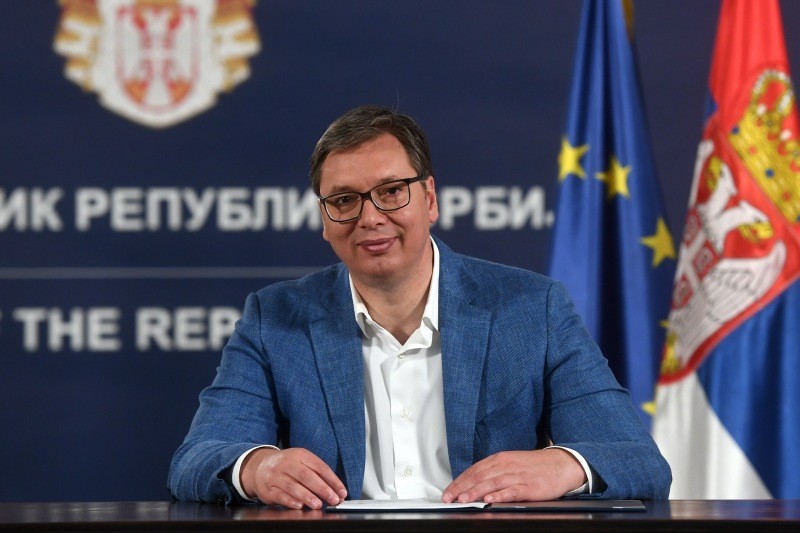
The main question now is what kind of power structure the parliamentary elections and the presidential election that follows will create in Serbia, especially since political competition in the country has intensified markedly even though the polls paint opposite pictures. CRTA and Stanford University’s Deliberative Action Lab (DAL) found over the summer that the Student List, which emerged in 2024 amid protests after the collapse of the canopy at Novi Sad railway station, was ahead. A September 16–20 poll by Faktor Plus gave Vučić’s list 48.6% and the Student List 37.1%. Differences in methodology and timing, along with political polarization, make these figures more a sign of uncertainty in the electoral balance than a reliable indicator of voter preferences.
A different issue matters more for foreign policy. Regardless of the composition of the next cabinet, Serbia remains deeply tied to the EU economically, while maintaining relations with Russia on energy and Kosovo and expanding its economic engagement with China. A change of power is therefore more likely to affect the pace of foreign policy and some of its instruments than its basic geographic orientation. The most telling near-term test will be the fate of NIS: US sanctions are already forcing Belgrade to find a mechanism for Russian capital to exit without threatening oil refining or the domestic fuel market.
What has changed in the power structure
Vučić had prepared in advance for a shift from a presidential-centered system to one centered on the party and government. After the October 25 elections were called, he resigned, SNS officially announced him as its candidate for prime minister, and the Republic Electoral Commission registered a list bearing his name.
The transition period has several centers of power. Ana Brnabić, as speaker of the National Assembly, is serving as acting head of state. Current law limits this period to three months. Đuro Macut remains at the head of the government, but SNS evidently does not view him as a candidate for prime minister after the elections and has officially nominated Vučić. If a majority is formed around SNS, the likeliest personnel consequence is that the office of prime minister will become a more politically weighty post.
The opposition camp has also become more structured. The Republic Electoral Commission registered “Student List – Students Win”, a civic platform of academics, professionals, and public figures headed by cardiologist and professor Ilija Srdanović. Vladan Đokić, the rector of the University of Belgrade, who had earlier been discussed as a possible leading figure in the movement, is not on the registered list. The question of who could head an alternative cabinet or become a candidate in the presidential election therefore remains open.
The Student List’s electoral base is markedly more EU-oriented than that of SNS. According to a June CRTA/Stanford survey, 75% of the list’s supporters favored closer ties with the EU and only 10% with Russia; among SNS voters the ratio was almost the reverse, with 15% for the EU and 60% for Russia. If the Students come to power on a platform of restoring institutions, strengthening the rule of law, making contracts more transparent, and normalizing relations with Brussels, Russian-Serbian relations will likely begin to deteriorate gradually. The pace of that process, however, will be constrained by public sentiment, energy dependence, and the established economic ties with Russia.
Besides the two largest forces, the campaign also includes Ivica Dačić’s socialists, the pro-European coalition around Marinika Tepić and Zdravko Ponoš, Miloš Jovanović’s right-wing coalition, and the parties of national minorities. If neither the Serbian Progressive Party led by Vučić nor the Student List can win a majority on its own, small factions will play a larger role in forming the government than their own result would suggest.
Political prospects and main risks
The elections are taking place after a long period of protests and a marked rise in polarization between SNS supporters and opposition-minded forces, including differences in how they assess the state of democracy and the role of presidential power. That raises the importance not only of the final distribution of seats but also of the extent to which the result is accepted by political actors and society.
A separate risk lies in the post-vote period, where Western organizations have already stepped up their activity. OSCE/ODIHR has deployed a full-scale observation mission, and its preliminary findings are due on October 26. The pro-European Belgrade Centre for Security Policy has outlined several possible crisis trajectories, from a managed stalemate to a negotiated transition or escalation.
Analysts note that the first stage after the elections may prove more important than the campaign itself. Attention will have to focus on how quickly a majority is formed, SNS’s relations with the socialists and small factions, the Student List’s ability to work with other opposition forces, and preparations for the presidential election. If the result is contested and the protests continue, Serbia could enter a period of prolonged political uncertainty that would complicate decision-making on European integration, relations with Russia and China, the future of Oil Industry of Serbia (NIS), and major investment projects.
What changes for Russia
Vučić’s resignation in itself does not create an immediate political break with Russia. Russian-Serbian relations rest on energy ties, Moscow’s position on Kosovo in the UN Security Council, cultural ties, and the political inertia built up over time. Some of Russia’s old levers, however, are becoming less reliable. DGAP links this to the gradual decline of Russian influence in the Western Balkans after 2022, while acknowledging that Moscow still retains substantial capabilities in energy, the Kosovo issue, and the information environment.
The most concrete risk is tied to NIS, where MOL GROUP signed a preliminary agreement with Gazprom Neft to acquire a 56.15% stake in the company, while the Government of Serbia approved the principles for the company’s future governance. The deal remains unfinished and depends on regulatory approvals, including a US license. NIS also continues to seek special licenses from OFAC to operate, but the balancing act is becoming increasingly difficult: Belgrade wants to preserve relations with Moscow, but it cannot allow the sanctioned status of Russian capital to threaten the operation of key oil-refining infrastructure.
The main risk for Russia, then, is a gradual reduction of its most vulnerable economic levers, not necessarily a sharp political rupture. That process could continue even with SNS in power, since it is driven not only by European integration but also by direct US sanctions pressure. Moscow still matters to Belgrade on Kosovo and in political messaging, while China is taking an increasingly independent place as an investor and industrial partner.
If the Serbian Progressive Party loses its leading position, the pro-European forces will most likely partly follow the trajectory chosen by Hungary’s new government under Péter Magyar, including normalizing relations with the EU and lifting some restrictions on aid to Ukraine. That government later went so far as to call Russia a security threat, yet continued to purchase Russian energy and has not so far abandoned cooperation on critically important projects.
How foreign policy may change
According to the European Commission, the EU accounted for 58.3% of Serbia’s foreign trade in 2024 and remains the country’s largest trade and investment partner. Any next cabinet will therefore have to take account of access to the European market, investment, and the accession process regardless of campaign rhetoric. That same dependence also gives Brussels the ability to link deeper integration to institutional reform and to what the EU sees as the right foreign policy course.
If the government is formed around SNS and Vučić secures parliamentary support to move into the prime minister’s office, Serbia’s main external dependencies will remain: the EU will stay Serbia’s main economic anchor, China an important source of investment and infrastructure cooperation, and Russia a partner on energy and Kosovo. The changes will consist mainly of gradual adaptation to Western pressure: one way or another, Belgrade will have to address issues it could previously postpone, including NIS’s ownership structure, diversification of energy supplies, and certain elements of sanctions compliance.
If forces associated with the Student List and other opposition actors form the cabinet, the fastest shift is likely in domestic institutional policy—in electoral rules, the transparency of government contracts, and investigations into major infrastructure projects—which will almost certainly be aimed at improving relations with Brussels and accelerating European integration. But the nature of the protest movement does not automatically imply sanctions against Russia, recognition of Kosovo, or movement toward NATO, especially since the platform is ideologically heterogeneous and a unified foreign policy doctrine has not yet been formed.
The coming political cycle will therefore answer two different questions. The first is whether Vučić will retain the central role in the power system as a potential head of government, or whether the parliamentary configuration will create a different executive center. The second is whether Serbia can preserve its previous room for foreign policy maneuver. For Russia, the second process is more sensitive, as sanctions pressure around NIS, Serbia’s economic dependence on the EU, and China’s growing role are increasingly forcing Belgrade to revise its relations with Russia.
What to watch after October 25
Key indicators will be:
the composition of the parliamentary majority and the candidate for prime minister;
the timing of the presidential election and who takes part;
the preliminary assessment by OSCE/ODIHR and the reaction of the main political forces;
the decision on NIS’s future operations and the completion of the deal with MOL;
after the cabinet is formed, the first concrete decisions relating to the EU and Russia.
After the vote, the main indicator will be not so much the formal distribution of seats as the ability of one side to form a stable parliamentary majority. For SNS, an additional issue will be whether Vučić can become prime minister without major concessions to smaller parties; for the opposition, whether the Student List can reach agreement with other forces that ran separately.
The reaction to the vote will be no less important. The preliminary OSCE/ODIHR assessment, along with assessments by the media and think tanks, on October 26 will show how the West and the EU react, and how “satisfied” they are with the result. A prolonged dispute over the outcome could trigger a new wave of protests and potentially delay the formation of a government.
In foreign policy, the first practical indicators will be NIS’s further fate, energy arrangements with Russia, and the pace of rapprochement with the EU. Once the new cabinet is formed, what will matter most will no longer be statements but concrete decisions on sanctions compliance, energy diversification, and Kosovo. The combination of these decisions will show whether the previous balancing policy is being preserved or whether Belgrade is gradually moving toward closer coordination with Brussels.